
Weeks 1–2
Pain
Calm the pain down.
Hands-on work settles the irritated tissue and the swelling, and we take the load off the knee without shutting you down completely.
What We Treat
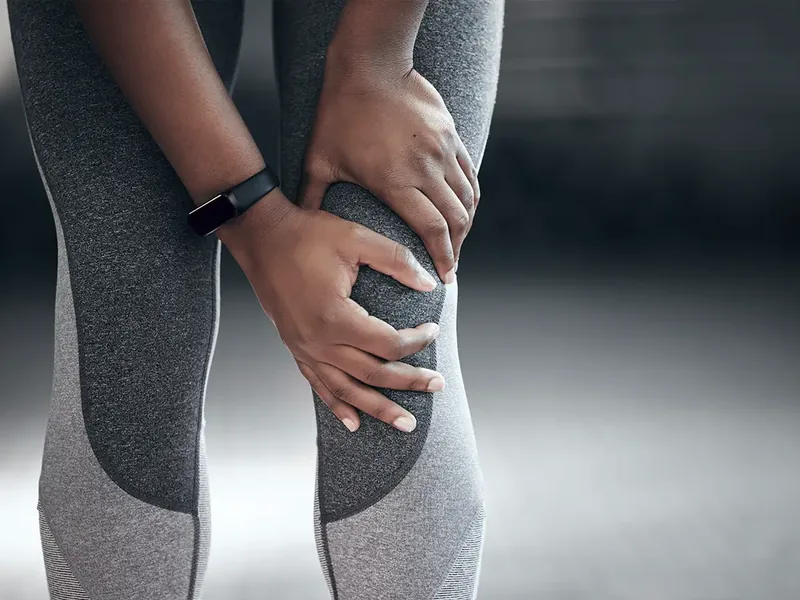
The stairs you now take one at a time. The ache that shows up two hours after the run, never during it. It’s fixable, and it starts with a cause-first evaluation, not a guess.
Sound Familiar?
Two or more? Keep reading.
Why It Happens
Knees don’t hurt for no reason. And it’s almost never just one thing. It’s usually some mix of four culprits: a tendon or a cartilage surface that got more load than it was ready for. A meniscus or joint surface that’s irritated and swelling after activity. Hips and glutes too weak to stop the knee caving inward every step. And a stiff ankle or a running and squatting pattern that quietly sends the work to the same spot every time.
None of that shows up on a quick glance. It takes a real, cause-first evaluation to sort out which one is driving your pain, because the knee is usually where a problem lands, not where it begins. That’s why rest, ice, or a generic stretching sheet so often falls short: they answer the symptom, not the source. You’ve been managing this quietly for months, working around it so nobody has to hear about it. That’s exactly why it’s worth one hour of somebody actually looking.
The Honest Truth
Nobody regrets starting early. The waiting is the part that costs you.
How We Fix It
Every plan has an endpoint. Here’s what the four phases look like for a knee.
Weeks 1–2
Pain
Hands-on work settles the irritated tissue and the swelling, and we take the load off the knee without shutting you down completely.
Weeks 2–6
Prime
Targeted mobility work gets full bend and full straightening back, at the knee, the hip, and the ankle above and below it.
Weeks 6–10
Perform
Progressive quad, glute, and calf strengthening builds the load tolerance the knee was missing in the first place.
Weeks 10+
Prevent
Stairs, squatting, and running mechanics get tested under real load before you’re cleared to go all-in: that’s the endpoint, not just another appointment.
I became connected with Elevate through a running club I am a part of. I had some issues with knee pain as a runner. Dan was my physical therapist who provided the therapy I needed to strengthen my knees and concentrate on my knee pain. His concern, expertise, and closely monitoring my progress were extremely helpful.
Shared by Rosie B. · Knee pain, runner
Phase one: settle the swelling so stairs stop being a decision
Phase four: squats and running mechanics tested under load, then you’re done
Questions, Answered
Usually not, and it’s rarely the first step. Scans routinely show meniscus wear and cartilage changes in people who have no knee pain at all, so a picture doesn’t always point at the cause. A hands-on exam tells us what the knee does under load, which is the part that actually drives your plan. We start with a cause-first evaluation, and if imaging ever becomes genuinely necessary, we’ll help you get it.
Complete rest is rarely the answer, and it’s usually not what we ask for. A knee that stops working entirely gets weaker, and weaker knees tolerate less. The job is finding the dose your knee can handle right now, then building it back up. That’s what a Doctor of Physical Therapy sorts out at your evaluation, and it’s why we test your running and squatting mechanics before we clear you.
That depends on what the evaluation finds, and you won’t be left guessing about it. At your first visit a Doctor of Physical Therapy maps your plan across all four phases, Pain, Prime, Perform, and Prevent, then tells you where you’re starting and what has to happen to finish. You get a plan with an endpoint: you’ll always know which phase you’re in and what’s left, not an open-ended string of appointments.
Book Your Visit
Request a time and a real person calls you back. No phone tree. No ‘someone will reach out.’ Just a plan.
5.0 · 120+ Google reviews
Typical response: under 2 business hours
Step 1 of 5
That’s the hard part done. We’ll call during business hours to lock in your time.
Visit Us